

The Constitution's Penman: Gouverneur Morris and the Creation of America's Basic Charter (American Political Thought
The Constitution's Penman: Gouverneur Morris and the Creation of America's Basic Charter (American Political Thought
Gouverneur Morris and the Creation of America's Basic Charter
Hardback
Couldn't load pickup availability
Join our rewards scheme and earn reward points on this purchase!
Earn points on this!
Sign in or Sign up!- Release Date: 21/02/2023
- Barcode: 9780700634149
- Genre: Society & Culture
- Sub-Genre: Politics & Government
- Imprint: University Press of Kansas
- Publisher: University Press of Kansas
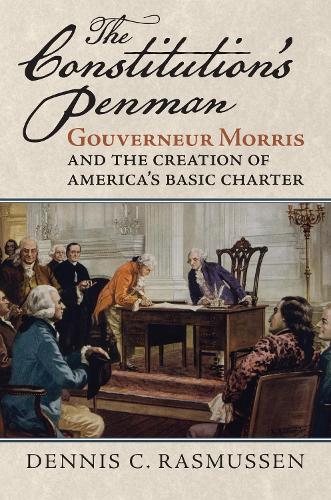

The Constitution's Penman: Gouverneur Morris and the Creation of America's Basic Charter (American Political Thought
Couldn't load pickup availability
Collapsible content
DESCRIPTION
Gouverneur Morris and the Creation of America's Basic Charter As Dennis Rasmussen deftly shows, some aspects of Morris’s political thought were intriguingly idiosyncratic, such as his argument that the Senate should be an aristocratic body whose members would serve life terms without pay. Other aspects of his vision for America’s constitutional order, however, were astoundingly prescient. Morris saw as clearly as any of the framers the need for a powerful executive with a popular mandate, the central role that parties would play in American politics, and the unfathomable evils that slavery would visit on American life. Rasmussen demonstrates that it is impossible to fully understand the Constitution without appreciating the central role that Morris played in shaping it.
Gouverneur Morris, who has been described as ‘the most colorful man in North America’ at the time of the founding, was a dominant figure at the Philadelphia Convention of 1787. Dennis Rasmussen demonstrates that it is impossible to fully understand the US Constitution without appreciating the central role that Morris played in shaping it.
Strikingly few Americans know who wrote the Constitution. Even fewer know that he was a peg-legged ladies’ man with a wicked sense of humor, a staunch opponent of slavery, and an unabashed elitist. Gouverneur Morris, who has been described as “the most colorful man in North America” at the time of the founding, was a dominant figure at the Philadelphia Convention of 1787. In fact, he spoke more often, proposed more motions, and had more motions adopted than any other delegate. He also put the Constitution into its final form, choosing the arrangement and much of the wording of its provisions, not to mention composing the famous preamble (“We the people of the United States .”) nearly from scratch. The Constitution’s Penman is the first book to explore the constitutional vision of this fascinating, neglected, and influential American.
DELIVERY & RETURNS
UK Delivery:
- Free delivery on all orders of £10 or more.
- £1.49 delivery fee on orders below £10.
- UK orders are shipped via Royal Mail 2nd Class.
International Delivery:
- Flat rate delivery charges vary by country.
Dispatch and Delivery Times:
- All orders are shipped from our warehouse in Northampton, UK as soon as stock is available.
- UK mainland orders typically arrive within 3-7 working days via Royal Mail 2nd Class.
- International estimated delivery times:
- Europe & Channel Islands: 7 to 10 working days
- USA: 7 to 15 working days
- Rest of the World: 9 to 30 working days
View our full delivery infomation here.
-
OVER
2 MILLION PRODUCTS
-
60 MILLION CUSTOMERS
ACROSS 190 COUNTRIES
You might also like
Loading recommendations...