

Post-Imperial Possibilities
Post-Imperial Possibilities
Eurasia, Eurafrica, Afroasia
Hardback
Couldn't load pickup availability
Join our rewards scheme and earn 93 reward points on this purchase!
Earn 93 points on this!
Sign in or Sign up!- Release Date: 07/11/2023
- Barcode: 9780691250373
- Genre: Non-Fiction
- Sub-Genre: History
- Imprint: Princeton University Press
- Publisher: Princeton University Press

Post-Imperial Possibilities
Couldn't load pickup availability
Collapsible content
DESCRIPTION
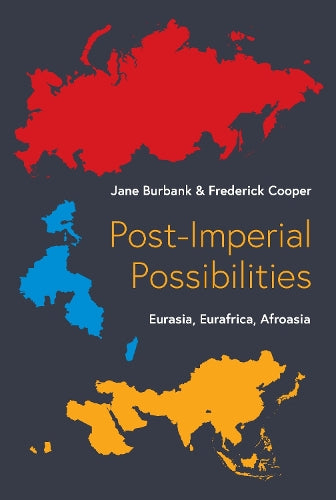
Eurasia, Eurafrica, Afroasia A history of three transnational political projects designed to overcome the inequities of imperialism
After the dissolution of empires, was the nation-state the only way to unite people politically, culturally, and economically? In Post-Imperial Possibilities, historians Jane Burbank and Frederick Cooper examine three large-scale, transcontinental projects aimed at bringing together peoples of different regions to mitigate imperial legacies of inequality. Eurasia, Eurafrica, and Afroasia—in theory if not in practice—offered alternative routes out of empire.
The theory of Eurasianism was developed after the collapse of imperial Russia by exiled intellectuals alienated by both Western imperialism and communism. Eurafrica began as a design for collaborative European exploitation of Africa but was transformed in the 1940s and 1950s into a project to include France’s African territories in plans for European integration. The Afroasian movement wanted to replace the vertical relationship of colonizer and colonized with a horizontal relationship among former colonial territories that could challenge both the communist and capitalist worlds.
Both Eurafrica and Afroasia floundered, victims of old and new vested interests. But Eurasia revived in the 1990s, when Russian intellectuals turned the theory’s attack on Western hegemony into a recipe for the restoration of Russian imperial power. While both the system of purportedly sovereign states and the concentrated might of large economic and political institutions continue to frustrate projects to overcome inequities in welfare and power, Burbank and Cooper’s study of political imagination explores wide-ranging concepts of social affiliation and obligation that emerged after empire and the reasons for their unlike destinies.
DELIVERY & RETURNS
UK Delivery:
- Free delivery on all orders of £10 or more.
- £1.49 delivery fee on orders below £10.
- UK orders are shipped via Royal Mail 2nd Class.
International Delivery:
- Flat rate delivery charges vary by country.
Dispatch and Delivery Times:
- All orders are shipped from our warehouse in Northampton, UK within 48 hours of receipt during working hours.
- UK mainland orders typically arrive within 3-5 working days via Royal Mail 2nd Class.
- International estimated delivery times:
- Europe & Channel Islands: 7 to 10 working days
- USA: 7 to 15 working days
- Rest of the World: 9 to 21 working days
View our full delivery infomation here.
-
OVER
2 MILLION PRODUCTS
-
60 MILLION CUSTOMERS
ACROSS 190 COUNTRIES
You might also like
Loading recommendations...