

The Papers of Thomas Jefferson, Volume 30
The Papers of Thomas Jefferson, Volume 30
1 January 1798 to 31 January 1799
Hardback
Couldn't load pickup availability
Join our rewards scheme and earn reward points on this purchase!
Earn points on this!
Sign in or Sign up!- Release Date: 26/01/2003
- Barcode: 9780691094984
- Genre: History
- Sub-Genre: History of the Americas
- Imprint: Princeton University Press
- Publisher: Princeton University Press
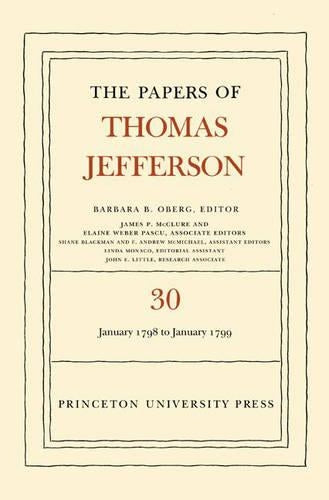

The Papers of Thomas Jefferson, Volume 30
Couldn't load pickup availability
Collapsible content
DESCRIPTION
1 January 1798 to 31 January 1799
Covers events in the thirteen months of the author's time in Philadelphia serving as vice president under President John Adams and presiding over a Senate that was dominated by his political opponents, the Federalists.
During the thirteen months covered by this volume, Thomas Jefferson spent more than half of his time in Philadelphia serving as vice president under President John Adams and presiding over a Senate that was dominated by his political opponents, the Federalists. Debates in Congress took place against a backdrop of bitter partisan rivalry, characterized most famously by the near-brawl on the floor of the House between Matthew Lyon and Roger Griswold. Congress and the nation waited, in a "state of extraordinary suspense," for dispatches from the American envoys in France. When the accounts of the XYZ Affair became public, the nation prepared for war. Two days after the Alien Friends Act was signed into law Jefferson left for Monticello, stopping at Montpelier to convey the latest news to James Madison. Disheartened and frustrated by the Alien and Sedition Acts, Jefferson penned the famous resolutions adopted in November by the Kentucky legislature. He kept his authorship a secret, however, seeking to avoid any appearance of "rashness" by Republicans.This endeavor reflected his struggle to make sense of the political direction of the nation in times he could neither comprehend nor accept. Jefferson continued to engage in scientific pursuits and fulfill his role as a promoter of American science and learning. He was reelected to the presidency of the American Philosophical Society, to which he presented his paper on the moldboard plow. He corresponded on American Indian languages, astronomy, and the Anglo-Saxon language. He longed for Monticello, and, as Jefferson had learned before, his property fell into neglect when he was away on public business. Renovations to the house slowed, supplies for the nailery were disrupted, and he had to arrange for the sale of his crops through intermediaries. With the prices of wheat low, he was drawn back into financial dependence on tobacco.
ADDITIONAL DETAILS
DELIVERY & RETURNS
UK Delivery:
- Free delivery on all orders of £10 or more.
- £1.49 delivery fee on orders below £10.
- UK orders are shipped via Royal Mail 2nd Class.
International Delivery:
- Flat rate delivery charges vary by country.
Dispatch and Delivery Times:
- All orders are shipped from our warehouse in Northampton, UK as soon as stock is available.
- UK mainland orders typically arrive within 3-7 working days via Royal Mail 2nd Class.
- International estimated delivery times:
- Europe & Channel Islands: 7 to 10 working days
- USA: 7 to 15 working days
- Rest of the World: 9 to 30 working days
View our full delivery infomation here.
-
OVER
2 MILLION PRODUCTS
-
60 MILLION CUSTOMERS
ACROSS 190 COUNTRIES
You might also like
Loading recommendations...