

Barlaam and Ioasaph
Barlaam and Ioasaph
Hardback
Couldn't load pickup availability
Join our rewards scheme and earn reward points on this purchase!
Earn points on this!
Sign in or Sign up!- Release Date: 01/01/1914
- Barcode: 9780674990388
- Publisher: Harvard University Press
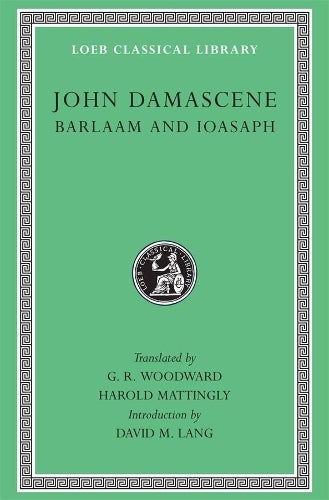

Barlaam and Ioasaph
Couldn't load pickup availability
Collapsible content
DESCRIPTION
Barlaam and Ioasaph, a hagiographic novel in which an Indian prince becomes aware of the world’s miseries and is converted to Christianity by a monk, is a Christianized version of the legend of the Buddha. Though often attributed to John Damascene (ca. AD 676–749), it was probably translated from Georgian into Greek in the eleventh century. A princely tale inspired by Christianity and Buddhism.
One of the best known examples of the hagiographic novel, this is the tale of an Indian prince who becomes aware of the world’s miseries and is converted to Christianity by the monk Barlaam. Barlaam and Josaphat (Ioasaph) were believed to have re-converted India after her lapse from conversion to Christianity, and they were numbered among the Christian saints. Centuries ago likenesses were noticed between the life of Josaphat and the life of the Buddha; the resemblances are in incidents, doctrine, and philosophy, and Barlaam’s rules of abstinence resemble the Buddhist monk’s. But not till the mid-nineteenth century was it recognized that, in Josaphat, the Buddha had been venerated as a Christian saint for about a thousand years.
The origin of the story of Barlaam and Ioasaph—which in itself has little peculiar to Buddhism—appears to be a Manichean tract produced in Central Asia. It was welcomed by the Arabs and by the Georgians. The Greek romance of Barlaam appears separately first in the 11th century. Most of the Greek manuscripts attribute the story to John the Monk, and it is only some later scribes who identify this John with John Damascene (ca. 676–749). There is strong evidence in Latin and Georgian as well as Greek that it was the Georgian Euthymius (who died in 1028) who caused the story to be translated from Georgian into Greek, the whole being reshaped and supplemented. The Greek romance soon spread throughout Christendom, and was translated into Latin, Old Slavonic, Armenian, and Arabic. An English version (from Latin) was used by Shakespeare in his caskets scene in The Merchant of Venice.
David M. Lang’s Introduction traces parallels between the Buddhist and Christian legends, discusses the importance of Arabic versions, and notes influences of the Manichean creed.
ADDITIONAL DETAILS
DELIVERY & RETURNS
UK Delivery:
- Free delivery on all orders of £10 or more.
- £1.49 delivery fee on orders below £10.
- UK orders are shipped via Royal Mail 2nd Class.
International Delivery:
- Flat rate delivery charges vary by country.
Dispatch and Delivery Times:
- All orders are shipped from our warehouse in Northampton, UK within 48 hours of receipt during working hours.
- UK mainland orders typically arrive within 3-5 working days via Royal Mail 2nd Class.
- International estimated delivery times:
- Europe & Channel Islands: 7 to 10 working days
- USA: 7 to 15 working days
- Rest of the World: 9 to 21 working days
View our full delivery infomation here.
-
OVER
2 MILLION PRODUCTS
-
60 MILLION CUSTOMERS
ACROSS 190 COUNTRIES
You might also like
Loading recommendations...