

A Marvelous Solitude
A Marvelous Solitude
The Art of Reading in Early Modern Europe
Hardback
Couldn't load pickup availability
Join our rewards scheme and earn reward points on this purchase!
Earn points on this!
Sign in or Sign up!- Release Date: 05/12/2023
- Barcode: 9780674660236
- Imprint: Harvard University Press
- Publisher: Harvard University Press
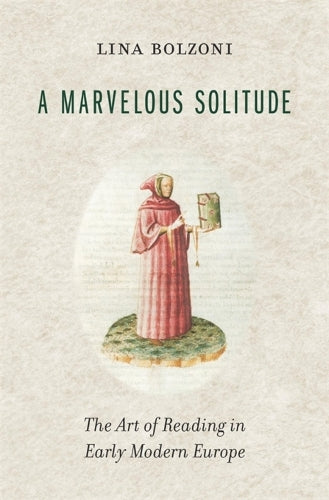

A Marvelous Solitude
Couldn't load pickup availability
Collapsible content
DESCRIPTION
The Art of Reading in Early Modern Europe A Times Literary Supplement Best Book of the Year
The sense of reading as an intimate act of self-discovery—and of communion between authors and book lovers—has a long history. Lina Bolzoni returns to Petrarch, Boccaccio, Machiavelli, Montaigne, and Tasso, exploring how Renaissance humanists began to represent reading as a private encounter and a dialogue across barriers of time and space.
A preeminent Renaissance scholar illuminates early modern encounters with books, in which literature became a portal to self-awareness and miraculous communion between author and reader.
The experience of reading is often presented as personal and transformative—a journey of self-discovery and, perhaps, renewal. In A Marvelous Solitude, Lina Bolzoni examines the early modern roots of this attitude toward the readerly act. Between the fourteenth and sixteenth centuries, European men of letters increasingly came to see books as something more than compendia of knowledge: they could also help readers understand the human condition. As Bolzoni shows, Petrarch, Boccaccio, Machiavelli, Montaigne, and Tasso all presented reading as a private encounter and a dialogue with the author.
For many Renaissance intellectuals, reading was instrumental to the construction of the self, which was enriched by contact with other learned men. These readers imagined the book as a mirror image of its author, with whom they held a secret affinity. In their letters to one another, humanists described the book as a body, reflecting the notion that reading literature placed its author in the room with oneself. Reading the work of a deceased author became akin to a necromantic rite, as the writers of bygone times were resurrected and placed in contemporary conversation. The vogue for hanging portraits of authors in libraries and studios ensured that the image of the creator was never far from his words, cementing bonds of friendship across barriers of time.
These myths—charming, fragile, and powerful—invested the readerly encounter with miraculous properties that lingered in the hearts of the Romantics. And something of those wonders persists today, in the intimate feeling that reading yet provokes.
ADDITIONAL DETAILS
DELIVERY & RETURNS
UK Delivery:
- Free delivery on all orders of £10 or more.
- £1.49 delivery fee on orders below £10.
- UK orders are shipped via Royal Mail 2nd Class.
International Delivery:
- Flat rate delivery charges vary by country.
Dispatch and Delivery Times:
- All orders are shipped from our warehouse in Northampton, UK as soon as stock is available.
- UK mainland orders typically arrive within 3-7 working days via Royal Mail 2nd Class.
- International estimated delivery times:
- Europe & Channel Islands: 7 to 10 working days
- USA: 7 to 15 working days
- Rest of the World: 9 to 30 working days
View our full delivery infomation here.
-
OVER
2 MILLION PRODUCTS
-
60 MILLION CUSTOMERS
ACROSS 190 COUNTRIES
You might also like
Loading recommendations...