

Ancient Greek Horsemanship
Ancient Greek Horsemanship
Paperback
Couldn't load pickup availability
Join our rewards scheme and earn reward points on this purchase!
Earn points on this!
Sign in or Sign up!- Release Date: 15/07/2022
- Barcode: 9780520326439
- Genre: History
- Sub-Genre: European History
- Imprint: University of California Press
- Publisher: University of California Press
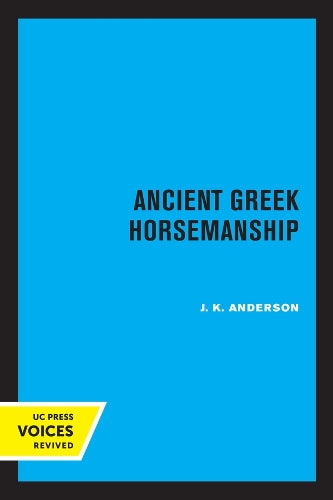

Ancient Greek Horsemanship
Couldn't load pickup availability
Collapsible content
DESCRIPTION
In ancient Greece, the arrival of the horse marked a turning point in military and cultural practices, introduced initially by invaders who relied on the animal for their chariots. Unlike the regions of Asia and Egypt, where chariot warfare flourished on vast plains, Greece’s rugged terrain and limited pasture made widespread chariot use and horse breeding challenging. The imported horses were generally small, spirited animals suited to the compact plains of Greece and the needs of the noble classes who primarily maintained them. Greek mythology and early art reflect this special status; horses appear often in scenes of hunting or chariot racing, as seen in Mycenaean seal stones, but rarely in depictions of mounted riders, indicating that horseback riding was still uncommon. Over time, as grazing land limitations persisted, many horses had to be imported from more fertile regions, and domestic breeding was confined largely to a wealthy elite.
By the 8th century B.C., significant changes began to reshape Greek society, military tactics, and horsemanship. Influences from Mesopotamia, Asia Minor, and Egypt—combined with internal shifts—pushed Greek warfare from noble chariot duels toward phalanx-style infantry combat, accessible to a broader social class. Additionally, the reintroduction of eastern goods, the Phoenician alphabet, and orientalizing art motifs sparked a cultural renaissance that coincided with Greece’s expanding use of horses, now more often as mounts. This shift toward horseback riding gained public interest, exemplified by the establishment of mounted horse races at the Olympic Games in 648 B.C. Yet, even as riding gained popularity, the skill remained secondary to the noble class’s dedication to the chariot; horses, whether ridden or driven, continued to symbolize status and power in Greek society, a tradition that shaped the evolution of horsemanship in classical Greece.
This title is part of UC Press's Voices Revived program, which commemorates University of California Press’s mission to seek out and cultivate the brightest minds and give them voice, reach, and impact. Drawing on a backlist dating to 1893, Voices Revived makes high-quality, peer-reviewed scholarship accessible once again using print-on-demand technology. This title was originally published in 1961.
ADDITIONAL DETAILS
DELIVERY & RETURNS
UK Delivery:
- Free delivery on all orders of £10 or more.
- £1.49 delivery fee on orders below £10.
- UK orders are shipped via Royal Mail 2nd Class.
International Delivery:
- Flat rate delivery charges vary by country.
Dispatch and Delivery Times:
- All orders are shipped from our warehouse in Northampton, UK within 48 hours of receipt during working hours.
- UK mainland orders typically arrive within 3-5 working days via Royal Mail 2nd Class.
- International estimated delivery times:
- Europe & Channel Islands: 7 to 10 working days
- USA: 7 to 15 working days
- Rest of the World: 9 to 21 working days
View our full delivery infomation here.
-
OVER
2 MILLION PRODUCTS
-
60 MILLION CUSTOMERS
ACROSS 190 COUNTRIES
You might also like
Loading recommendations...