


Qazaq Pastoralists in Western Mongolia
Qazaq Pastoralists in Western Mongolia
Hardback
Couldn't load pickup availability
Join our rewards scheme and earn reward points on this purchase!
Earn points on this!
Sign in or Sign up!- Release Date: 31/08/2023
- Barcode: 9780367700850
- Genre: Society & Culture
- Subgenre: Social Sciences

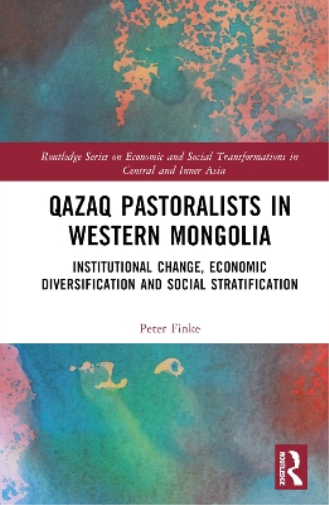

Qazaq Pastoralists in Western Mongolia
Couldn't load pickup availability
Collapsible content
DESCRIPTION
Institutional Change, Economic Diversification and Social Stratification. This book looks at the first longitudinal analysis of the Qazaqs in Mongolia and is a contribution to anthropological theories of economic & social inequalities & institutional change, useful for Cent. Asian Studies, Anthropology, Human Geography & Dev. Studies. Taking the case of Qazaq Pastoralists in Western Mongolia, this book looks at the universal human requirement to balance individual flexibility and strategies designed to make a living with the social expectations that impose particular rules of conduct but also enable mutual trust and cooperation to emerge. Pastoralists in Western Mongolia have experienced dramatic changes in recent decades, including the dismantling of the socialist economy, a series of natural disasters, and an emigration of roughly half of the local Qazaq minority to the newly independent state of Qazaqstan. Four aspects illustrate the chances and challenges that people face. First is the emergence of the market as the dominant mode of production and exchange, a thorny way full of uncertainties. Second is the individual household and its adaptation to the new economic system, creating new opportunities as well as precarities, and resulting in rapid social stratification. Thirdly, patterns of pastoral land allocation highlight problems of collective action and institutional fragmentation in the wake of a retreating state apparatus. Finally, social networks of mutual support and cooperation constitute a key component of pastoral livelihood but are under great pressure due to short time horizons and a lack of trust. The first longitudinal analysis of the Qazaqs in Mongolia in English and a contribution to anthropological theories on human adaptability and decision-making, economic and social inequalities, institutional change and the difficulty of deriving at cooperative solutions, this book will be a standard work and of interest to academics in the field of Central Asian Studies, Anthropology, Human Geography and Development Studies.
DELIVERY & RETURNS
UK Delivery:
- Free delivery on all orders of £10 or more.
- £1.49 delivery fee on orders below £10.
- UK orders are shipped via Royal Mail 2nd Class.
International Delivery:
- Flat rate delivery charges vary by country.
Dispatch and Delivery Times:
- All orders are shipped from our warehouse in Northampton, UK as soon as stock is available.
- UK mainland orders typically arrive within 3-7 working days via Royal Mail 2nd Class.
- International estimated delivery times:
- Europe & Channel Islands: 7 to 10 working days
- USA: 7 to 15 working days
- Rest of the World: 9 to 30 working days
View our full delivery infomation here.
-
OVER
2 MILLION PRODUCTS
-
60 MILLION CUSTOMERS
ACROSS 190 COUNTRIES
You might also like
Loading recommendations...