

Gender, Intersectionality and Climate Institutions in Industrialised States
Gender, Intersectionality and Climate Institutions in Industrialised States
Hardback
Couldn't load pickup availability
Join our rewards scheme and earn reward points on this purchase!
Earn points on this!
Sign in or Sign up!- Release Date: 17/06/2021
- Barcode: 9780367512057
- Genre: Science Nature & Math
- Subgenre: Technology & Engineering
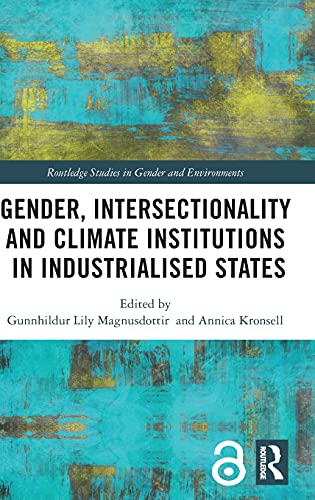

Gender, Intersectionality and Climate Institutions in Industrialised States
Couldn't load pickup availability
Collapsible content
DESCRIPTION
This book explores how climate institutions in industrialised countries work to further recognition of social differences and integrate this understanding in climate policy making. It will be of great interest to students and scholars of climate politics, international relations, gender studies and policy studies. This book explores how climate institutions in industrialized countries work to further the recognition of social differences and integrate this understanding in climate policy making. With contributions from a range of expert scholars in the field, this volume investigates policy-making in climate institutions from the perspective of power as it relates to gender. It also considers other intersecting social factors at different levels of governance, from the global to the local level and extending into climate-relevant sectors. The authors argue that a focus on climate institutions is important since they not only develop strategies and policies, they also (re)produce power relations, promote specific norms and values, and distribute resources. The chapters throughout draw on examples from various institutions including national ministries, transport and waste management authorities, and local authorities, as well as the European Union and the UNFCCC regime. Overall, this book demonstrates how feminist institutionalist theory and intersectionality approaches can contribute to an increased understanding of power relations and social differences in climate policy-making and in climate-relevant sectors in industrialized states. In doing so, it highlights the challenges of path dependencies, but also reveals opportunities for advancing gender equality, equity, and social justice. Gender, Intersectionality and Climate Institutions in Industrialized States will be of great interest to students and scholars of climate politics, international relations, gender studies and policy studies. The Open Access version of this book, available at https://doi.org/10.4324/9781003052821, has been made available under a Creative Commons Attribution-Non Commercial-No Derivatives 4.0 license.
DELIVERY & RETURNS
UK Delivery:
- Free delivery on all orders of £10 or more.
- £1.49 delivery fee on orders below £10.
- UK orders are shipped via Royal Mail 2nd Class.
International Delivery:
- Flat rate delivery charges vary by country.
Dispatch and Delivery Times:
- All orders are shipped from our warehouse in Northampton, UK as soon as stock is available.
- UK mainland orders typically arrive within 3-7 working days via Royal Mail 2nd Class.
- International estimated delivery times:
- Europe & Channel Islands: 7 to 10 working days
- USA: 7 to 15 working days
- Rest of the World: 9 to 30 working days
View our full delivery infomation here.
-
OVER
2 MILLION PRODUCTS
-
60 MILLION CUSTOMERS
ACROSS 190 COUNTRIES
You might also like
Loading recommendations...