

Paper and the British Empire
Paper and the British Empire
The Quest for Imperial Raw Materials, 1861–1960
Hardback
Couldn't load pickup availability
Join our rewards scheme and earn reward points on this purchase!
Earn points on this!
Sign in or Sign up!- Release Date: 29/12/2020
- Barcode: 9780367341565
- Imprint: Routledge
- Publisher: Taylor & Francis
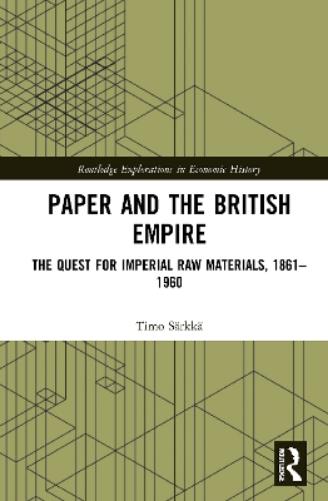

Paper and the British Empire
Couldn't load pickup availability
Collapsible content
DESCRIPTION
The Quest for Imperial Raw Materials, 1861–1960 Paper and the British Empire examines the evolution of the paper industry within British organisational frameworks, and highlights the role of the Empire as a market and business-making area in a world of shrinking commerce and rising trade barriers. Paper and the British Empire examines the evolution of the paper industry within British organisational frameworks and highlights the role of the Empire as a market and business-making area in a world of shrinking commerce and rising trade barriers. Drawing on a valuable range of primary sources, this book covers the period 1861–1960 and examines events from the establishment of free trade backed by the gold standard to Britain’s membership of the European Free Trade Association. In the field of the paper industry, the speed and intensity of the industrialisation process around the globe have been shaped by a wide variety of variables, including the surrounding institutional framework; entrepreneurial and organisational strategies; the cost and accessibility of transport; and the availability of capital, knowledge, energy resources, and technology. The supply of papermaking raw materials has also been key and has historically been the most important determinant for geographical location and dominance. The research in this work focuses on the roles played by such variants, on the one hand, and demand characteristics on the other. In particular, it considers developments connected to a quest for Empire-grown raw materials in order to tackle the problem of the lack of indigenous raw materials and the resulting dependence on Scandinavian wood pulp imports. This text is of considerable interest to advanced students and researchers in economic history, business history, and the paper industry, and will also be useful to organisations working within the pulp and paper industries.
DELIVERY & RETURNS
UK Delivery:
- Free delivery on all orders of £10 or more.
- £1.49 delivery fee on orders below £10.
- UK orders are shipped via Royal Mail 2nd Class.
International Delivery:
- Flat rate delivery charges vary by country.
Dispatch and Delivery Times:
- All orders are shipped from our warehouse in Northampton, UK within 48 hours of receipt during working hours.
- UK mainland orders typically arrive within 3-5 working days via Royal Mail 2nd Class.
- International estimated delivery times:
- Europe & Channel Islands: 7 to 10 working days
- USA: 7 to 15 working days
- Rest of the World: 9 to 21 working days
View our full delivery infomation here.
-
OVER
2 MILLION PRODUCTS
-
60 MILLION CUSTOMERS
ACROSS 190 COUNTRIES
You might also like
Loading recommendations...