

Democracy at the Point of Bayonets
Democracy at the Point of Bayonets
Paperback
Couldn't load pickup availability
Join our rewards scheme and earn reward points on this purchase!
Earn points on this!
Sign in or Sign up!- Release Date: 15/08/1999
- Barcode: 9780271018836
- Genre: Law & Politics
- Imprint Family: Pennsylvania State University Press
- Publisher: Pennsylvania State University Press
- Subgenre: Society & Culture
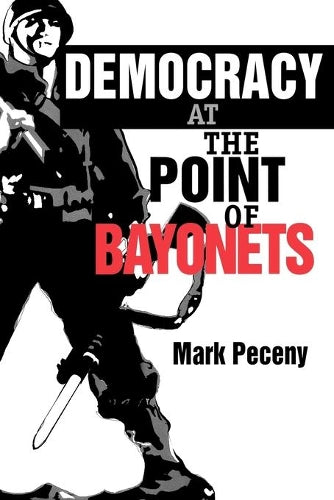

Democracy at the Point of Bayonets
Couldn't load pickup availability
Collapsible content
DESCRIPTION
An examination of the promotion of democracy during US military interventions in the 20th century. The work shows this to be one of the central ways in which the US attempts to reconcile the potential contradictions involved in being a liberal great power. No country has worked harder to coerce others to adopt liberal institutions than the United States. This book examines the promotion of democracy during U.S. military interventions in the twentieth century, showing it to be one of the central ways in which the United States attempts to reconcile the potential contradictions involved in being a liberal great power. Examining interventions from the Spanish-American War through recent actions in Bosnia, Mark Peceny shows how the United States has encouraged the institution of free elections and other liberal reforms—often at the point of bayonets. Peceny applies statistical analysis to ninety-three cases of intervention and presents six case studies: Cuba and the Philippines after the Spanish-American War, Vietnam during the Kennedy administration, El Salvador during Reagan's first term, and Clinton's interventions in Haiti and Bosnia. By forging a synthesis of realist and domestic liberal approaches, Peceny illuminates the roles that both security concerns and liberal values play in the formulation and implementation of foreign policy. He shows how presidents often initially choose proliberalization policies to serve U.S. security interests and how Congress exerts pressure when presidents fail to take the initiative. Under these circumstances, he shows, presidents use the promotion of democracy to build domestic political consensus and to legitimize interventions. Although the United States has failed to promote democracy in most interventions, Peceny demonstrates that it has often had a profound and positive impact on the democratization of target states. His study offers new insight into the relationship between American power, the promotion of democracy, and prospects for the liberal peace in the decades to come.
DELIVERY & RETURNS
UK Delivery:
- Free delivery on all orders of £10 or more.
- £1.49 delivery fee on orders below £10.
- UK orders are shipped via Royal Mail 2nd Class.
International Delivery:
- Flat rate delivery charges vary by country.
Dispatch and Delivery Times:
- All orders are shipped from our warehouse in Northampton, UK within 48 hours of receipt during working hours.
- UK mainland orders typically arrive within 3-5 working days via Royal Mail 2nd Class.
- International estimated delivery times:
- Europe & Channel Islands: 7 to 10 working days
- USA: 7 to 15 working days
- Rest of the World: 9 to 21 working days
View our full delivery infomation here.
-
OVER
2 MILLION PRODUCTS
-
60 MILLION CUSTOMERS
ACROSS 190 COUNTRIES
You might also like
Loading recommendations...