

The Weaving of Mantra
The Weaving of Mantra
Kukai and the Construction of Esoteric Buddhist Discourse
Paperback
Couldn't load pickup availability
Join our rewards scheme and earn reward points on this purchase!
Earn points on this!
Sign in or Sign up!- Release Date: 25/10/2000
- Barcode: 9780231112871
- Genre: Philosophy & Spirituality
- Sub-Genre: Theology
- Imprint: Columbia University Press
- Publisher: Columbia University Press
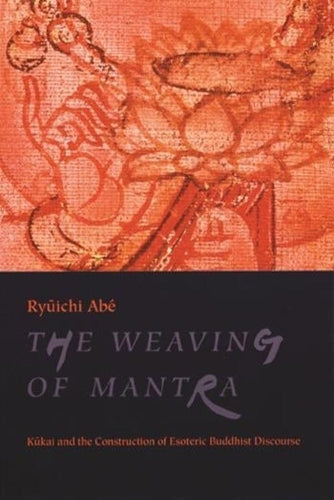

The Weaving of Mantra
Revised Edition
Couldn't load pickup availability
Collapsible content
DESCRIPTION
Kukai and the Construction of Esoteric Buddhist Discourse
Examines the Buddhist priest Kukai's influence on Japanese culture. This book contends that the importance of Kukai's transmission of esoteric Buddhism to Japan lay in his creation of a general theory of language grounded in the ritual speech of mantra. It explores the rhetorical strategies Kukai employed in his works.
The great Buddhist priest Kukai (774-835) is credited with the introduction and establishment of tantric -or esoteric -Buddhism in early ninth-century Japan. In Ryuichi Abe examines this important religious figure -neglected in modern academic literature -and his profound influence on Japanese culture. Offering a radically new approach to the study of early religious history -combining historical research, discourse analysis, literary criticism, and semiology -Abe contends that the importance of Kukai's transmission of esoteric Buddhism to Japan lay not in the foundation of a new sect but in his creation of a general theory of language grounded in the ritual speech of mantra. embeds Kukai within the fabric of political and social life in ninth-century Japan and explains how esoteric Buddhism played a crucial role in many societal changes in Japan -from the growth of monasteries into major feudal powers to the formation of the native phonetic alphabet, kana. As Abe illustrates, Kukai's writings and the new type of discourse they spawned also marked Japan's transition from the ancient order to the medieval world, replacing Confucianism as the ideology of the state.Abe begins by placing Kukai's life in the historical context of medieval Japan and the Ritsuryo state, then explores his interaction with the Nara Buddhist intelligentsia, which was seminal to the introduction of esoteric Buddhism. The author discusses Kukai's magnum opus, () and introduces a number of Japanese and Chinese primary-source texts previously unknown by Western-language scholars. Instead of tracing Kukai's thought through literal readings, explores the rhetorical strategies Kukai employed in his works, shedding valuable light on what his texts meant to his readers and what his goals were in creating a discourse that ultimately transformed Japanese culture. The great Buddhist priest Kukai (774-835) is credited with the introduction and establishment of tantric-or esoteric-Buddhism in early ninth-century Japan. In The Weaving of Mantra, Ryuichi Abe examines this important religious figure-neglected in modern academic literature-and his profound influence on Japanese culture.Offering a radically new approach to the study of early religious history-combining historical research, discourse analysis, literary criticism, and semiology-Abe contends that the importance of Kukai's transmission of esoteric Buddhism to Japan lay not in the foundation of a new sect but in his creation of a general theory of language grounded in the ritual speech of mantra. The Weaving of Mantra embeds Kukai within the fabric of political and social life in ninth-century Japan and explains how esoteric Buddhism played a crucial role in many societal changes in Japan-from the growth of monasteries into major feudal powers to the formation of the native phonetic alphabet, kana. As Abe illustrates, Kukai's writings and the new type of discourse they spawned also marked Japan's transition from the ancient order to the medieval world, replacing Confucianism as the ideology of the state. Abe begins by placing Kukai's life in the historical context of medieval Japan and the Ritsuryo state, then explores his interaction with the Nara Buddhist intelligentsia, which was seminal to the introduction of esoteric Buddhism.The author discusses Kukai's magnum opus, Ten Abiding Stages on the Secret Mandalas (Himitsu mandara jujushinron) and introduces a number of Japanese and Chinese primary-source texts previously unknown by Western-language scholars. Instead of tracing Kukai's thought through literal readings, The Weaving of Mantra explores the rhetorical strategies Kukai employed in his works, shedding valuable light on what his texts meant to his readers and what his goals were in creating a discourse that ultimately transformed Japanese culture.
ADDITIONAL DETAILS
DELIVERY & RETURNS
UK Delivery:
- Free delivery on all orders of £10 or more.
- £1.49 delivery fee on orders below £10.
- UK orders are shipped via Royal Mail 2nd Class.
International Delivery:
- Flat rate delivery charges vary by country.
Dispatch and Delivery Times:
- All orders are shipped from our warehouse in Northampton, UK within 48 hours of receipt during working hours.
- UK mainland orders typically arrive within 3-5 working days via Royal Mail 2nd Class.
- International estimated delivery times:
- Europe & Channel Islands: 7 to 10 working days
- USA: 7 to 15 working days
- Rest of the World: 9 to 21 working days
View our full delivery infomation here.
-
OVER
2 MILLION PRODUCTS
-
60 MILLION CUSTOMERS
ACROSS 190 COUNTRIES
You might also like
Loading recommendations...