

From Stone to Flesh
From Stone to Flesh
A Short History of the Buddha
Hardback
Couldn't load pickup availability
Join our rewards scheme and earn reward points on this purchase!
Earn points on this!
Sign in or Sign up!- Release Date: 11/04/2013
- Barcode: 9780226493206
- Genre: Philosophy & Spirituality
- Sub-Genre: Theology
- Imprint: University of Chicago Press
- Publisher: The University of Chicago Press
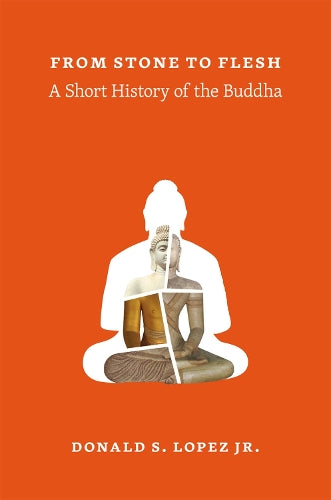

From Stone to Flesh
Couldn't load pickup availability
Collapsible content
DESCRIPTION
A Short History of the Buddha
The credit for creating Buddhism goes to the Buddha. But who was this Buddha, and how did he become the Buddha we know and love today? This book follows the twists and turns of Eastern and Western notions of the Buddha, leading finally to his triumph as the founder of a world religion.
We have come to admire Buddhism for being profound but accessible, as much a lifestyle as a religion. The credit for creating Buddhism goes to the Buddha, a figure widely respected across the Western world for his philosophical insight, his teachings of nonviolence, and his practice of meditation. But who was this Buddha, and how did he become the Buddha we know and love today? Leading historian of Buddhism Donald S. Lopez Jr. tells the story of how various idols carved in stone - variously named Beddou, Codam, Xaca, and Fo - became the man of flesh and blood that we know simply as the Buddha. He reveals that the positive view of the Buddha in Europe and America is rather recent, originating a little more than 150 years ago. For centuries, the Buddha was condemned by Western writers as the most dangerous idol of the Orient. He was a demon, the murderer of his mother, a purveyor of idolatry. Lopez provides an engaging history of depictions of the Buddha from classical accounts and medieval stories to the testimonies of European travelers, diplomats, soldiers, and missionaries.Lopez shows that centuries of hostility toward the Buddha changed dramatically in the nineteenth century, when the teachings of the Buddha, having disappeared from India by the fourteenth century, were read by European scholars newly proficient in Asian languages. At the same time, the traditional view of the Buddha persisted in Asia, where he was revered as much for his supernatural powers as for his philosophical insights. "From Stone to Flesh" follows the twists and turns of these Eastern and Western notions of the Buddha, leading finally to his triumph as the founder of a world religion.
DELIVERY & RETURNS
UK Delivery:
- Free delivery on all orders of £10 or more.
- £1.49 delivery fee on orders below £10.
- UK orders are shipped via Royal Mail 2nd Class.
International Delivery:
- Flat rate delivery charges vary by country.
Dispatch and Delivery Times:
- All orders are shipped from our warehouse in Northampton, UK as soon as stock is available.
- UK mainland orders typically arrive within 3-7 working days via Royal Mail 2nd Class.
- International estimated delivery times:
- Europe & Channel Islands: 7 to 10 working days
- USA: 7 to 15 working days
- Rest of the World: 9 to 30 working days
View our full delivery infomation here.
-
OVER
2 MILLION PRODUCTS
-
60 MILLION CUSTOMERS
ACROSS 190 COUNTRIES
You might also like
Loading recommendations...