

Prometheus Shackled
Prometheus Shackled
Goldsmith Banks and England's Financial Revolution after 1700
Hardback
Couldn't load pickup availability
Join our rewards scheme and earn reward points on this purchase!
Earn points on this!
Sign in or Sign up!- Release Date: 14/02/2013
- Barcode: 9780199944279
- Imprint: Oxford University Press
- Publisher: Oxford University Press
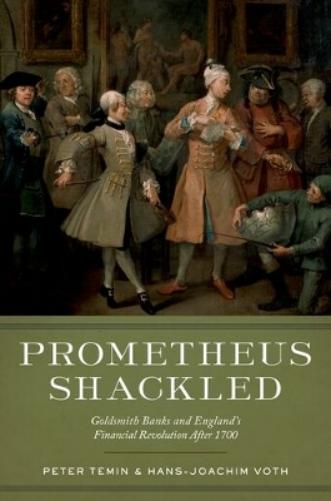

Prometheus Shackled
Couldn't load pickup availability
Collapsible content
DESCRIPTION
Goldsmith Banks and England's Financial Revolution after 1700
Using new archival data from goldsmith banks, Temin and Voth document how government regulation and wartime financing stifled the growth of private credit markets during the Industrial Revolution. They show how, after a turbulent start, banks adapted and found a way to grow, but how the economy at large lost out.
After 1688, Britain underwent a revolution in public finance, and the cost of borrowing declined sharply. Leading scholars have argued that easier credit for the government, made possible by better property-rights protection, lead to a rapid expansion of private credit. The Industrial Revolution, according to this view, is the result of the preceding revolution in public finance.In Prometheus Shackled, prominent economic historians Peter Temin and Hans-Joachim Voth examine this hypothesis using new, detailed archival data from 18th century banks. They conclude the opposite: the financial revolution led to an explosion of public debt, but it stifled private credit. This led to markedly slower growth in the English economy. Temin and Voth collected detailed data from several goldsmith banks-Child's, Gosling's, Freame and Gould, Hoare's, and Duncombe and Kent. The excellent records from Hoare's, founded by Sir Richard Hoare in 1672, offer particular insight.Numerous entrants into the banking business tried their hand at deposit-taking and lending in the early 17th century; few survived and fewer thrived. Hoare's and a small group of competitors did both. Temin and Voth chart the growth of the successful banks in the face of frequent wars and heavy-handed regulations. Their new data allows insights into the interaction between financial and economic development. Government regulations such as (a sharply lower) maximum interest rate caused severe misallocation of credit, and a misguided attempt to lighten the nation's debt burden led directly to the South Sea Bubble in 1720. Frequent wars caused banks to call in loans, resulting in a sharply slower economic growth rate. Based on detailed micro-data, the authors present conclusive evidence that wartime borrowing crowded out investment. Far from fostering economic development, England's financial revolution after 1688 did much to stifle it -- the Hanoverian "warfare state" was a key reason for slow growth during Britain's Industrial Revolution. Prometheus Shackled is a revealing new take on one of the most important periods of economic and financial development.
DELIVERY & RETURNS
UK Delivery:
- Free delivery on all orders of £10 or more.
- £1.49 delivery fee on orders below £10.
- UK orders are shipped via Royal Mail 2nd Class.
International Delivery:
- Flat rate delivery charges vary by country.
Dispatch and Delivery Times:
- All orders are shipped from our warehouse in Northampton, UK within 48 hours of receipt during working hours.
- UK mainland orders typically arrive within 3-5 working days via Royal Mail 2nd Class.
- International estimated delivery times:
- Europe & Channel Islands: 7 to 10 working days
- USA: 7 to 15 working days
- Rest of the World: 9 to 21 working days
View our full delivery infomation here.
-
OVER
2 MILLION PRODUCTS
-
60 MILLION CUSTOMERS
ACROSS 190 COUNTRIES
You might also like
Loading recommendations...