

The Waning of Materialism
The Waning of Materialism
Paperback
Couldn't load pickup availability
Join our rewards scheme and earn reward points on this purchase!
Earn points on this!
Sign in or Sign up!- Release Date: 25/03/2010
- Barcode: 9780199556199
- Genre: Philosophy & Spirituality
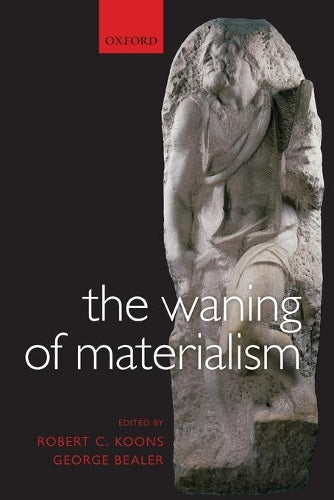

The Waning of Materialism
Couldn't load pickup availability
Collapsible content
DESCRIPTION
This is a sustained critique of materialism (the thesis that all reality consists of material particles, their relations and interactions). The contributors offer arguments from conscious experience, rational thought, the interaction of mind and body, and the unity and persisting identity of human persons, and develop a wide range of alternatives.
Twenty-three philosophers examine the doctrine of materialism find it wanting. The case against materialism comprises arguments from conscious experience, from the unity and identity of the person, from intentionality, mental causation, and knowledge. The contributors include leaders in the fields of philosophy of mind, metaphysics, ontology, and epistemology, who respond ably to the most recent versions and defences of materialism. The modal arguments of Kripke and Chalmers, Jackson's knowledge argument, Kim's exclusion problem, and Burge's anti-individualism all play a part in the building of a powerful cumulative case against the materialist research program. Several papers address the implications of contemporary brain and cognitive research (the psychophysics of color perception, blindsight, and the effects of commissurotomies), adding a posteriori arguments to the classical a priori critique of reductionism. All of the current versions of materialism -- reductive and non-reductive, functionalist, eliminativist, and new wave materialism -- come under sustained and trenchant attack. In addition, a wide variety of alternatives to the materialist conception of the person receive new and illuminating attention, including anti-materialist versions of naturalism, property dualism, Aristotelian and Thomistic hylomorphism, and non-Cartesian accounts of substance dualism.
DELIVERY & RETURNS
UK Delivery:
- Free delivery on all orders of £10 or more.
- £1.49 delivery fee on orders below £10.
- UK orders are shipped via Royal Mail 2nd Class.
International Delivery:
- Flat rate delivery charges vary by country.
Dispatch and Delivery Times:
- All orders are shipped from our warehouse in Northampton, UK as soon as stock is available.
- UK mainland orders typically arrive within 3-7 working days via Royal Mail 2nd Class.
- International estimated delivery times:
- Europe & Channel Islands: 7 to 10 working days
- USA: 7 to 15 working days
- Rest of the World: 9 to 30 working days
View our full delivery infomation here.
-
OVER
2 MILLION PRODUCTS
-
60 MILLION CUSTOMERS
ACROSS 190 COUNTRIES
You might also like
Loading recommendations...