

Enlightened Oxford
Enlightened Oxford
The University and the Cultural and Political Life of Eighteenth-Century Britain and Beyond
Hardback
Couldn't load pickup availability
Join our rewards scheme and earn reward points on this purchase!
Earn points on this!
Sign in or Sign up!- Release Date: 19/10/2023
- Barcode: 9780199246830
- Imprint: Oxford University Press
- Publisher: Oxford University Press
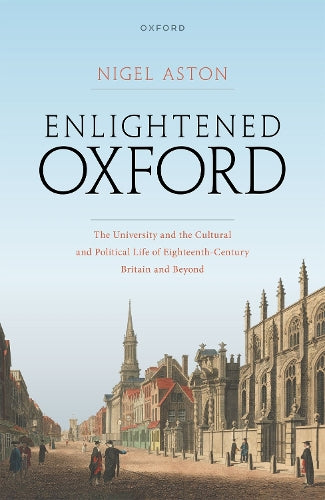

Enlightened Oxford
Couldn't load pickup availability
Collapsible content
DESCRIPTION
The University and the Cultural and Political Life of Eighteenth-Century Britain and Beyond
Enlightened Oxford takes a fresh look at the eighteenth-century University of Oxford and its relation to the state, society, and religion of the time, and how a long-established institution managed to navigate the multiple political challenges of the era while maintaining a cultural presence and a surprising capacity for adaptability.
Enlightened Oxford aims to discern, establish, and clarify the multiplicity of connections between the University of Oxford, its members, and the world outside; to offer readers a fresh, contextualised sense of the University's role in the state, in society, and in relation to other institutions between the Williamite Revolution and the first decade of the nineteenth century, the era loosely describable (though not without much qualification) as England's ancien regime.Nigel Aston asks where Oxford fitted in to the broader social and cultural picture of the time, locating the University's importance in Church and state, and pondering its place as an institution that upheld religious entitlement in an ever-shifting intellectual world where national and confessional boundaries were under scrutiny. Enlightened Oxford is less an inside history than a consideration of an institutional presence and its place in the life of the country and further afield. While admitting the degree of corporate inertia to be found in the University, there was internal scope for members so inclined to be creative in their teaching, open new research lines, and be unapologetic Whigs rather than unrepentant Tories. For if Oxford was a seat of learning rooted in its past - and with an increasing antiquarian awareness of its inheritance - yet it had a surprising capacity for adaptation, a scope for intellectual and political pluralism that was not incompatible with enlightened values.
DELIVERY & RETURNS
UK Delivery:
- Free delivery on all orders of £10 or more.
- £1.49 delivery fee on orders below £10.
- UK orders are shipped via Royal Mail 2nd Class.
International Delivery:
- Flat rate delivery charges vary by country.
Dispatch and Delivery Times:
- All orders are shipped from our warehouse in Northampton, UK as soon as stock is available.
- UK mainland orders typically arrive within 3-7 working days via Royal Mail 2nd Class.
- International estimated delivery times:
- Europe & Channel Islands: 7 to 10 working days
- USA: 7 to 15 working days
- Rest of the World: 9 to 30 working days
View our full delivery infomation here.
-
OVER
2 MILLION PRODUCTS
-
60 MILLION CUSTOMERS
ACROSS 190 COUNTRIES
You might also like
Loading recommendations...