

Neurocognitive Mechanisms
Neurocognitive Mechanisms
Hardback
Couldn't load pickup availability
Join our rewards scheme and earn reward points on this purchase!
Earn points on this!
Sign in or Sign up!- Release Date: 12/11/2020
- Barcode: 9780198866282
- Genre: Language & Reference
- Subgenre: Science Nature & Math
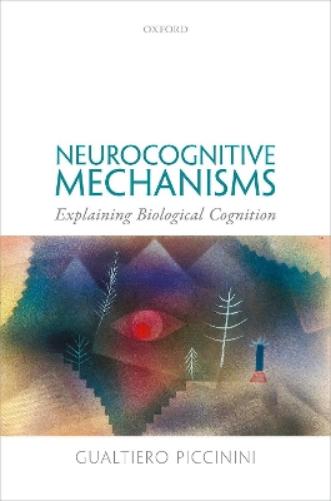

Neurocognitive Mechanisms
Couldn't load pickup availability
Collapsible content
DESCRIPTION
Explaining Biological Cognition. Gualtiero Piccinini presents a systematic and rigorous philosophical defence of the computational theory of cognition. His view posits that cognition involves neural computation within multilevel neurocognitive mechanisms, and includes novel ideas about ontology, functions, neural representation, neural computation, and consciousness. In Neurocognitive Mechanisms Gualtiero Piccinini presents the most systematic, rigorous, and comprehensive philosophical defence to date of the computational theory of cognition. His view posits that cognition involves neural computation within multilevel neurocognitive mechanisms, and includes novel ideas about ontology, functions, neural representation, neural computation, and consciousness. He begins by defending an ontologically egalitarian account of composition and realization, according to which all levels are equally real. He then explicates multiple realizability and mechanisms within this ontologically egalitarian framework, defends a goal-contribution account of teleological functions, and defends a mechanistic version of functionalism. This provides the foundation for a mechanistic account of computation, which in turn clarifies the ways in which the computational theory of cognition is a multilevel mechanistic theory supported by contemporary cognitive neuroscience. Piccinini argues that cognition is computational at least in a generic sense. He defends the computational theory of cognition from standard objections, yet also rebuts putative a priori arguments. He contends that the typical vehicles of neural computations are representations, and that, contrary to the received view, the representations posited by the computational theory of cognition are observable and manipulatable in the laboratory. He also contends that neural computations are neither digital nor analog; instead, neural computations are sui generis. He concludes by investigating the relation between computation and consciousness, suggesting that consciousness may be a functional phenomenon without being computational in nature. This book will be of interest to philosophers of cognitive science as well as neuroscientists.
DELIVERY & RETURNS
UK Delivery:
- Free delivery on all orders of £10 or more.
- £1.49 delivery fee on orders below £10.
- UK orders are shipped via Royal Mail 2nd Class.
International Delivery:
- Flat rate delivery charges vary by country.
Dispatch and Delivery Times:
- All orders are shipped from our warehouse in Northampton, UK as soon as stock is available.
- UK mainland orders typically arrive within 3-7 working days via Royal Mail 2nd Class.
- International estimated delivery times:
- Europe & Channel Islands: 7 to 10 working days
- USA: 7 to 15 working days
- Rest of the World: 9 to 30 working days
View our full delivery infomation here.
-
OVER
2 MILLION PRODUCTS
-
60 MILLION CUSTOMERS
ACROSS 190 COUNTRIES
You might also like
Loading recommendations...