

Law and the Political Economy of Hunger
Law and the Political Economy of Hunger
Hardback
Couldn't load pickup availability
Join our rewards scheme and earn reward points on this purchase!
Earn points on this!
Sign in or Sign up!- Release Date: 07/02/2019
- Barcode: 9780198823940
- Genre: Science Nature & Math
- Subgenre: Law & Politics
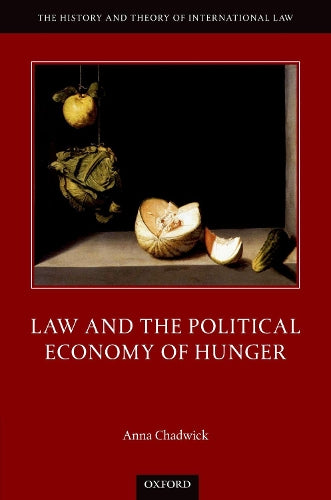

Law and the Political Economy of Hunger
Couldn't load pickup availability
Collapsible content
DESCRIPTION
After the global food crisis of 2007-2011, many Non-Government Organizations blamed speculators trading in commodity derivatives, viewing speculator driven high price volatility in grain markets as culpable for the disaster. Chadwick disagrees, arguing that current legal regimes bear far more responsibility for the tragedy of world hunger. This book is an inquiry into the role of law in the contemporary political economy of hunger. In the work of many international institutions, governments, and NGOs, law is represented as a solution to the persistence of hunger. This presentation is evident in the efforts to realize a human right to adequate food, as well as in the positioning of law, in the form of regulation, as a tool to protect society from 'unruly' markets. In this monograph, Anna Chadwick draws on theoretical work from a range of disciplines to challenge accounts that portray law's role in the context of hunger as exclusively remedial. The book takes as its starting point claims that financial traders 'caused' the 2007-8 global food crisis by speculating in financial instruments linked to the prices of staple grains. The introduction of new regulations to curb the 'excesses' of the financial sector in order to protect the food insecure reinforces the dominant perception that law can solve the problem. Chadwick investigates a number of different legal regimes spanning public international law, international economic law, transnational governance, private law, and human rights law to gather evidence for a counterclaim: law is part of the problem. The character of the contemporary global food system-a food system that is being progressively 'financialized'-owes everything to law. If world hunger is to be eradicated, Chadwick argues, then greater attention needs to be paid to how different legal regimes operate to consistently privilege the interests of the wealthy few over the needs of poor and the hungry.
DELIVERY & RETURNS
UK Delivery:
- Free delivery on all orders of £10 or more.
- £1.49 delivery fee on orders below £10.
- UK orders are shipped via Royal Mail 2nd Class.
International Delivery:
- Flat rate delivery charges vary by country.
Dispatch and Delivery Times:
- All orders are shipped from our warehouse in Northampton, UK within 48 hours of receipt during working hours.
- UK mainland orders typically arrive within 3-5 working days via Royal Mail 2nd Class.
- International estimated delivery times:
- Europe & Channel Islands: 7 to 10 working days
- USA: 7 to 15 working days
- Rest of the World: 9 to 21 working days
View our full delivery infomation here.
-
OVER
2 MILLION PRODUCTS
-
60 MILLION CUSTOMERS
ACROSS 190 COUNTRIES
You might also like
Loading recommendations...