

Evolutionary Ecology
Evolutionary Ecology
Paperback
Couldn't load pickup availability
Join our rewards scheme and earn reward points on this purchase!
Earn points on this!
Sign in or Sign up!- Release Date: 25/08/2005
- Barcode: 9780198527862
- Genre: Science Nature & Math
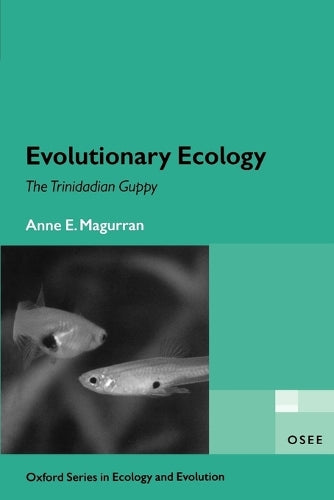

Evolutionary Ecology
Couldn't load pickup availability
Collapsible content
DESCRIPTION
The Trinidadian Guppy. Presents an account of the evolutionary ecology of the guppy. This book shows how guppies provided some of the first evidence of sperm competition and sexual selection, and how they inform scientific thought on mating systems and cryptic choice. It is useful to students and researchers in the fields of behavioural ecology and evolutionary biology. This book celebrates the guppy's unique contribution to evolutionary ecology. Ever since Caryl Haskins described guppy populations as a 'natural experiment' because of the way predation pressure varies over a small geographical area, generations of researchers have been drawn to Trinidad to investigate evolution in the wild. The species continues to provide classic examples of natural selection in action and elegantly illustrates how ecology, evolution, and behaviour are interlinked. Anne Magurran's account of the evolutionary ecology of the guppy integrates historical breakthroughs with new research in this fast-moving field. She reveals how guppies provided some of the first evidence of sperm competition and sexual selection, and how they continue to inform scientific thought on mating systems and cryptic choice. The consequences of variation in predation risk--as well as a host of other biotic and abiotic factors--are described and evaluated at all life stages from conception to death. The book discusses behavioural responses to ecological conditions alongside life history patterns. It examines the potential for ecological speciation and discusses new research into how reproductive isolating mechanisms become established in promiscuous mating systems. Conservation issues are also considered, both in terms of protecting the irreplaceable Trinidadian guppy system and in the context of invasion ecology. This timely synthesis of research into a species that has raised key questions in evolutionary ecology will be of great interest to graduate level students as well as professional researchers in the fields of behavioural ecology and evolutionary biology.
DELIVERY & RETURNS
UK Delivery:
- Free delivery on all orders of £10 or more.
- £1.49 delivery fee on orders below £10.
- UK orders are shipped via Royal Mail 2nd Class.
International Delivery:
- Flat rate delivery charges vary by country.
Dispatch and Delivery Times:
- All orders are shipped from our warehouse in Northampton, UK as soon as stock is available.
- UK mainland orders typically arrive within 3-7 working days via Royal Mail 2nd Class.
- International estimated delivery times:
- Europe & Channel Islands: 7 to 10 working days
- USA: 7 to 15 working days
- Rest of the World: 9 to 30 working days
View our full delivery infomation here.
-
OVER
2 MILLION PRODUCTS
-
60 MILLION CUSTOMERS
ACROSS 190 COUNTRIES
You might also like
Loading recommendations...