

Religion, Language and Community in the Roman Near East
Religion, Language and Community in the Roman Near East
Constantine to Muhammad
Hardback
Couldn't load pickup availability
Join our rewards scheme and earn reward points on this purchase!
Earn points on this!
Sign in or Sign up!- Release Date: 19/12/2013
- Barcode: 9780197265574
- Imprint: Oxford University Press
- Publisher: Oxford University Press
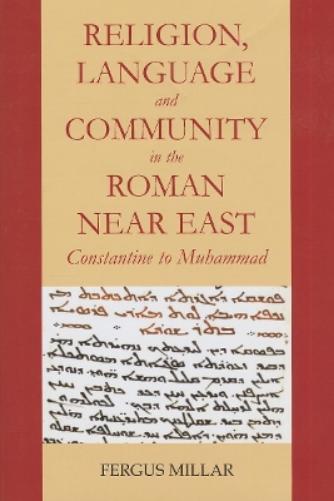

Religion, Language and Community in the Roman Near East
Couldn't load pickup availability
Collapsible content
DESCRIPTION
Constantine to Muhammad This book explores the way in which different ethnic, religious and linguistic communities co-existed and conflicted in the Roman Near East in the three centuries between the conversion of the Emperor Constantine to Christianity in 312 and the beginning of Muhammad's preaching in about 610. In the fourth century a major role was played by Greek-speaking pagans, most notably the great orator, Libanius, from Antioch in Syria. After about 400, however, the public observance of pagan rituals died away under the pressure of Christianity. But the Greek language, as used in the Church, remained dominant. Pagan Aramaic is curiously invisible in this period, but the dialect of Aramaic used by Jews in Palestine is found in very extensive use, along with Hebrew, in a mass of religious literature, including the Palestinian Talmud, Aramaic versions of books of the Bible, and in inscriptions from synagogues. Most of the synagogue inscriptions come from their often quite elaborate mosaic floors, some of which contain visual representations of scenes from the Bible. Jews used Greek also, even in the inscriptions from synagogues, and so too did Samaritans, who were a powerful force in Late Antique Palestine, mounting two major revolts against the Empire. Outside Palestine, the most notable development in the culture of the region was the emergence of Syriac (a particular dialect and script of Aramaic) as a language of Christian culture and belief. 'Syrians' however were not a distinct ethnic group. The group which was most distinct from the others was made up of the unsettled and warlike peoples on the fringes of the Empire whom almost invariably, call 'Arabs', but who in Late Antiquity were far more often referred to as 'Saracens'. By the end of the period, many of them had converted to Christianity. The major puzzle which the book poses is what is the relation between this process of conversion and the rise of Islam.
This is a lively portrayal of the ways in which different ethnic, religious and linguistic communities co-existed and conflicted in the Roman Near East in the three centuries between the conversion of the Emperor Constantine to Christianity in 312 and the beginning of Muhammad's preaching in about 610.
DELIVERY & RETURNS
UK Delivery:
- Free delivery on all orders of £10 or more.
- £1.49 delivery fee on orders below £10.
- UK orders are shipped via Royal Mail 2nd Class.
International Delivery:
- Flat rate delivery charges vary by country.
Dispatch and Delivery Times:
- All orders are shipped from our warehouse in Northampton, UK as soon as stock is available.
- UK mainland orders typically arrive within 3-7 working days via Royal Mail 2nd Class.
- International estimated delivery times:
- Europe & Channel Islands: 7 to 10 working days
- USA: 7 to 15 working days
- Rest of the World: 9 to 30 working days
View our full delivery infomation here.
-
OVER
2 MILLION PRODUCTS
-
60 MILLION CUSTOMERS
ACROSS 190 COUNTRIES
You might also like
Loading recommendations...