

Pseudo-Noun Incorporation and Differential Object Marking
Pseudo-Noun Incorporation and Differential Object Marking
Hardback
Couldn't load pickup availability
Join our rewards scheme and earn reward points on this purchase!
Earn points on this!
Sign in or Sign up!- Release Date: 30/03/2023
- Barcode: 9780192866400
- Genre: Language & Reference
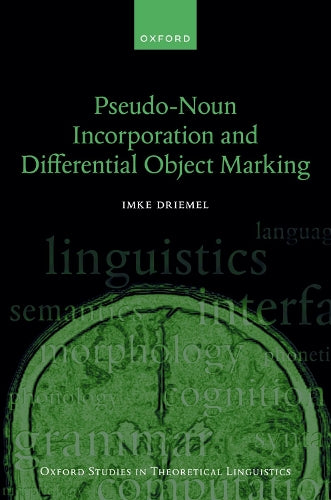

Pseudo-Noun Incorporation and Differential Object Marking
Couldn't load pickup availability
Collapsible content
DESCRIPTION
This book provides a detailed cross-linguistic study of pseudo-noun incorporation, a phenomenon whereby an argument forms a 'closer than usual' relation with the verb. Imke Driemel explores eleven noun types across five different languages to arrive at a unifying theory that accounts for all properties of pseudo-noun incorporation. This book provides a detailed cross-linguistic study of pseudo-noun incorporation, a phenomenon whereby an argument forms a 'closer than usual' relation with the verb. Imke Driemel draws on data from Tamil, Mongolian, Korean, Turkish, and German, and applies diagnostic tests across eleven noun types in each of the languages under consideration. What emerges is a coherent effect of pseudo-incorporated arguments that maps loss of case marking to obligatory narrow scope, lack of binding and control relations, and a potentially restricted movement pattern. The book provides a unifying theory that is able to capture all properties with a single assumption: pseudo-incorporation effects result from noun phrases that are made up of a nominal and a verbal category feature; implemented in a derivational framework, the nominal feature is active early in the derivation, being responsible for c-selection and nominal modification, while the verbal feature is active late and crucially derives the effects we have come to recognize as pseudo-noun incorporation. One important empirical contribution of this study stems from the observation that pseudo-incorporation does not have to be the only reason for optional case marking. Tamil and Korean provide evidence that only a subset of optionally case-marked noun types also show a correlation with scope, binding, control, and movement constraints. This insight enforces the conclusion that the same language can make use of both pseudo-noun incorporation and differential object marking.
DELIVERY & RETURNS
UK Delivery:
- Free delivery on all orders of £10 or more.
- £1.49 delivery fee on orders below £10.
- UK orders are shipped via Royal Mail 2nd Class.
International Delivery:
- Flat rate delivery charges vary by country.
Dispatch and Delivery Times:
- All orders are shipped from our warehouse in Northampton, UK within 48 hours of receipt during working hours.
- UK mainland orders typically arrive within 3-5 working days via Royal Mail 2nd Class.
- International estimated delivery times:
- Europe & Channel Islands: 7 to 10 working days
- USA: 7 to 15 working days
- Rest of the World: 9 to 21 working days
View our full delivery infomation here.
-
OVER
2 MILLION PRODUCTS
-
60 MILLION CUSTOMERS
ACROSS 190 COUNTRIES
You might also like
Loading recommendations...