

ICRP Publication 69
ICRP Publication 69
Paperback
Couldn't load pickup availability
Join our rewards scheme and earn reward points on this purchase!
Earn points on this!
Sign in or Sign up!- Release Date: 01/07/1995
- Barcode: 9780080426587
- Genre: Business & Finance
- Imprint Family: Elsevier
- Publisher: Elsevier
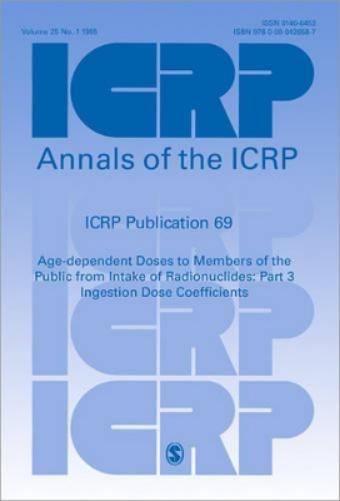

ICRP Publication 69
Couldn't load pickup availability
Collapsible content
DESCRIPTION
Age-dependent Doses to Members of the Public from Intake of Radionuclides: Part 3 Ingestion Dose Coefficients
Focuses on age dependent dose coefficients to members of the public follows ICRP Publications 56 and 67. This book gives parameters for the tissue distribution and retention of these elements together with data on urinary and faecal excretion.
Ingestion Dose Coefficients The present report on age dependent dose coefficients to members of the public follows ICRP Publications 56 and 67. The following elements are covered: iron, selenium, antimony, thorium and uranium. This report gives parameters for the tissue distribution and retention of these elements together with data on urinary and faecal excretion. Dose coefficients have been calculated for radioisotopes of these elements which are expected to be released into the environment as a result of human activities and are considered to be of significance for environmental radiation protection purposes. The generic model structure for plutonium, americium and neptunium given in ICRP Publication 67 has been applied to thorium; the generic model structure for the alkaline earths given in ICRP Publication 67 has been applied to uranium. Where no clear evidence on age dependence of organ distribution and retention appeared to be available, the biokinetic data for adults were adopted for infants and children. This assumption was made in ICRP Publications 56 and 67, and is usually expected to lead to an overestimate of the dose coefficient. If no relevant biokinetic data were found for humans, appropriate data were based on animal experiments as far as possible.
DELIVERY & RETURNS
UK Delivery:
- Free delivery on all orders of £10 or more.
- £1.49 delivery fee on orders below £10.
- UK orders are shipped via Royal Mail 2nd Class.
International Delivery:
- Flat rate delivery charges vary by country.
Dispatch and Delivery Times:
- All orders are shipped from our warehouse in Northampton, UK within 48 hours of receipt during working hours.
- UK mainland orders typically arrive within 3-5 working days via Royal Mail 2nd Class.
- International estimated delivery times:
- Europe & Channel Islands: 7 to 10 working days
- USA: 7 to 15 working days
- Rest of the World: 9 to 21 working days
View our full delivery infomation here.
-
OVER
2 MILLION PRODUCTS
-
60 MILLION CUSTOMERS
ACROSS 190 COUNTRIES
You might also like
Loading recommendations...