


Divertissements D818 and D823 (Andreas, Staier, Lubimov)
Divertissements D818 and D823 (Andreas, Staier, Lubimov)
CD
Couldn't load pickup availability
Join our rewards scheme and earn reward points on this purchase!
Earn points on this!
Sign in or Sign up!- Release Date: 23/02/2004
- Barcode: 0825646081127
- Edition: Album
- Genre: Classical
- Label Family: Elatus
- Subgenre: Chamber

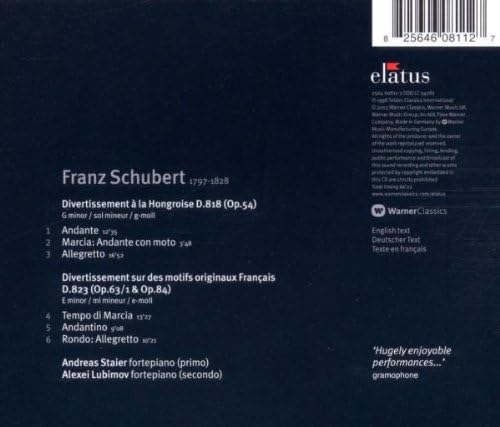

Divertissements D818 and D823 (Andreas, Staier, Lubimov)
Album
Couldn't load pickup availability
Collapsible content
DESCRIPTION
Schubert's musical training took place during the traditions of early Classicism. Beethoven, on the other hand, described the most disparate pieces as ‘sonatas’ and in doing so had redefined the genre for his own specific ends, investing it with an aesthetic ambition that it had never previously enjoyed. Schubert retained the nicely differentiated taxonomies of early Classicism throughout his career. For Schubert, a ‘sonata’ was always a three- or four-movement work with an opening movement in textbook sonata form, followed by a slow movement followed in turn by a scherzo or minuet, with a sonata-rondo finale. In a ‘fantasia’, by contrast, the individual formal sections succeeded each other without a break, although the sections themselves continued to recall the movements of a sonata in terms of the order in which they occurred, with the final section adopting the Baroque form of a fugue. Schubert’s divertissements would also have to be described as three-movement sonatas. The justification for the title ‘divertissements’ must be sought, therefore, not in formal characteristics, but in thematic and aesthetic considerations. The term ‘divertissement’ means ‘entertainment’ and is used for sonatas making less elevated claims for themselves and which, like marches and dances, belong to the world of salon music. Schubert writes them in quite a different style from that of his sonatas, a style aiming at brilliance. In the 19th century, the Divertissement à la Hongroise was one of Schubert's most popular piano works, transcribed by 1838 for piano solo by Liszt, while the first two movements of the Divertissement sur des motifs originaux Français were later transcribed by Liszt's pupil, Carl Tausig. ‘Hugely enjoyable performances.’ (Gramophone)
ADDITIONAL DETAILS
DELIVERY & RETURNS
UK Delivery:
- Free delivery on all orders of £10 or more.
- £1.49 delivery fee on orders below £10.
- UK orders are shipped via Royal Mail 2nd Class.
International Delivery:
- Flat rate delivery charges vary by country.
Dispatch and Delivery Times:
- All orders are shipped from our warehouse in Northampton, UK within 48 hours of receipt during working hours.
- UK mainland orders typically arrive within 3-5 working days via Royal Mail 2nd Class.
- International estimated delivery times:
- Europe & Channel Islands: 7 to 10 working days
- USA: 7 to 15 working days
- Rest of the World: 9 to 21 working days
View our full delivery infomation here.
-
OVER
2 MILLION PRODUCTS
-
60 MILLION CUSTOMERS
ACROSS 190 COUNTRIES
Fans of this product are also looking at...
Loading recommendations...