


Letter to Warsaw
Letter to Warsaw
CD
Couldn't load pickup availability
Join our rewards scheme and earn reward points on this purchase!
Earn points on this!
Sign in or Sign up!- Release Date: 19/02/2007
- Barcode: 0636943921920
- Genre: Pop

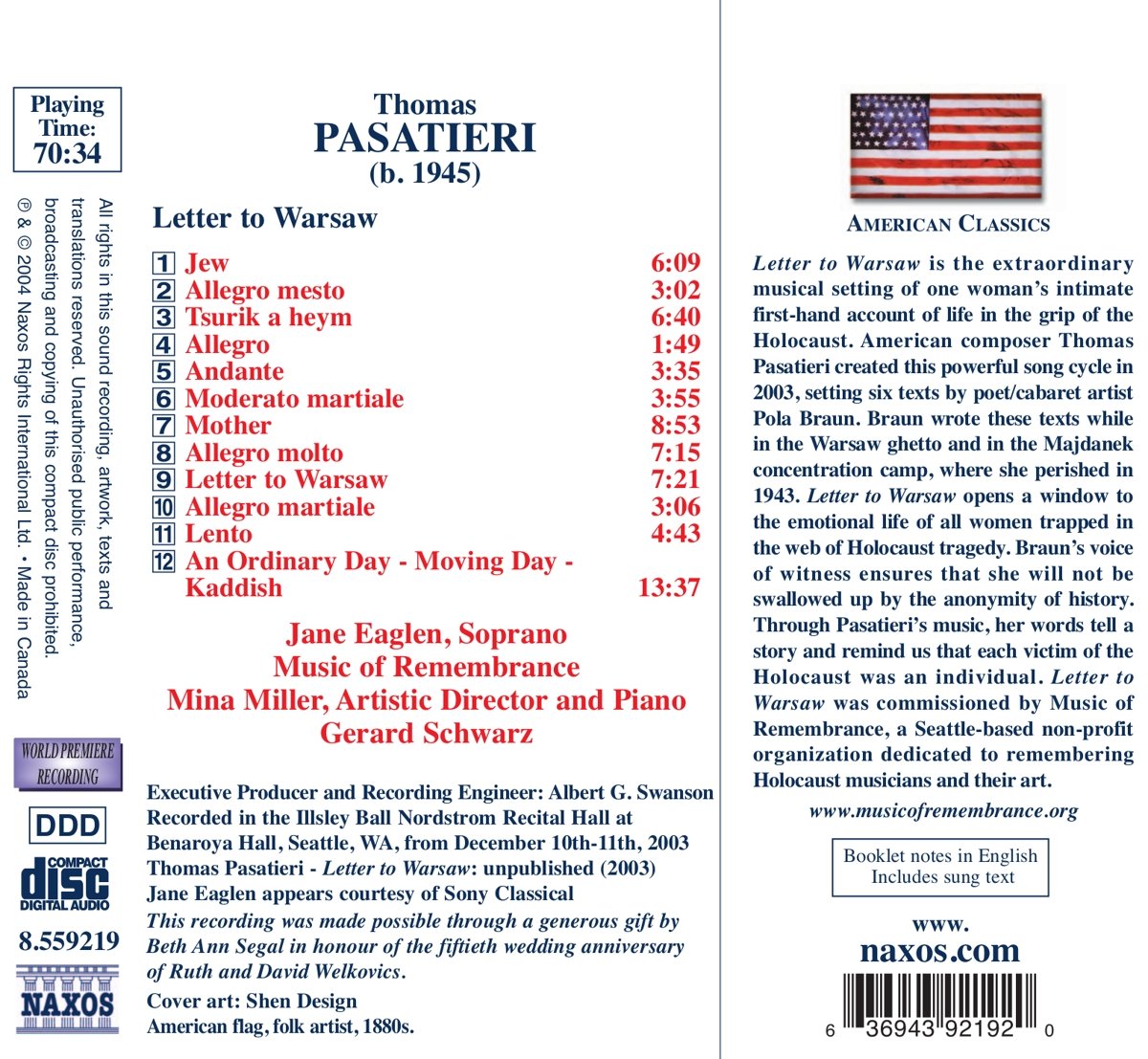

Letter to Warsaw
Couldn't load pickup availability
Collapsible content
DESCRIPTION
EDITORIAL REVIEWS
Daily performances at Sztuka were organized by a group of writers from the Living Journal, a satiric daily chronicle of the ghetto, written by a group of authors under the direction of Szlengel. Szpilman described these programmes as "a witty chronicle of ghetto life, full of sharp, risqué allusions to the Germans". The Sztuka was considered an elite club for the ghetto's few people of any means. First-person accounts of an evening at the Sztuka note the high quality of it's black-market coffee and caviar, and of the musical, humorous and satirical offerings. Those who could gathered for brief escape from the surrounding atmosphere of death and disease. Stepping outside meant a return to the ghetto's grim realities - the starving, diseased, and lice-infested ghetto population whose despairing cries for "Bread, Mercy, Death" quickly extinguished the Sztuka's fleeting moments of pleasure. In 1942, during the mass deportation of 300,000 Jews from the Warsaw ghetto to Treblinka, Pola Braun was assigned to the Ostdeutsche Bautischlerei-Werkstätte (OBW), an industrial plant, where her work helped postpone her own deportation for a period. It has not been established exactly when she was transported to Majdanek. At Majdanek she was active in the women's camp, along with other Polish political prisoners involved in the cultural life. Most of the women were from Warsaw, and many probably knew Pola Braun from before the war. Braun participated in the concerts organized by Polish prisoners from Pawiak, to whom we owe thanks for remembering and collecting some of Braun's poems. Braun was murdered on 3 November 1943, in the mass executions code-named Aktion Erntefest (Operation Harvest Festival) by the Nazis - the liquidation of approximately 42,000 Jewish prisoners from Majdanek and other concentration and labour camps in the Lublin district. Two of the six poems in this song cycle, "Jew" and "Tsurik a heym", were written during Braun's period in the Warsaw ghetto. The remaining four - "Mother", "Letter to Warsaw ", "Ordinary Day" and "Moving Day" - date from her incarceration in Majdanek. Braun sang her own songs, accompanying herself on the piano. These heartfelt songs stirred the emotions, particularly of Polish women from places other than Warsaw who identified with her message. Braun gave concerts at Majdanek in a barrack that contained furniture from the ghetto, including a piano. Several secret concerts were held there for the Jewish and Polish women prisoners. Braun's extant poetry was assembled after the war by historians. These include the Polish political dissident Aleksander Kulisiewicz, himself a prisoner in Sachsenhausen, who copied out variants of some of Braun's Majdanek pieces. Pola Braun's poems in Kleinkunst style are revealing in their observations about her surroundings, her deportation, and her Jewish identity. They open a window, especially, to the emotional life of all women caught inextricably in the web of Holocaust tragedy. Braun's voice of musical witness ensures that she will not be swallowed up by the anonymity of history. Through Thomas Pasatieri's music, her words will tell a story, and remind us that each of the victims of the Holocaust was an individual. Each had a life, a story, and aspirations beyond survival. Through this extraordinary music, we offer a tribute to the human spirit, and do our small part to honor the Holocaust's legacy.
AMAZON
This recording of a cycle of six songs separated by instrumental sections represents a fusion of two cultural worlds widely separated in time and space but strangely compatible in style and spirit. The texts are by Pola Braun, a Polish poet and cabaret artist born in 1910; two of the poems were written in the Warsaw ghetto, while the rest were written at the Majdanek concentration camp, where she was murdered in 1943. Before her deportation, Braun belonged to a literary group that met at the ghetto's "Szuka" café-cabaret; among its members was the pianist Wladyslaw Szpilman, whose war-time memoir became the basis for the film "The Pianist." The music is by Thomas Pasatieri, a prolific American composer of more than 400 songs and numerous operas. This background gives him a singular affinity for the cabaret-inflected but haunting, tragic nature of the poetry. His settings of Barbara Milewski's English translations follow the prosody with natural simplicity, and the instrumental accompaniments and interludes, played beautifully and very expressively by the ensemble, underline mood and atmosphere. The poems focus on the women's experience of the Holocaust with an anguish of numbing, wrenching depth and intensity. One describing four mothers who have lost their sons and, though of different nationalities, mourning them with the same maternal despair, is truly unbearable. The final song, sung in Hebrew, is the traditional Jewish prayer for the dead, the "Kaddish." Is this hymn of praise intended to contrast man's inhumanity with the greatness of God, or to cry out to Him for letting it run amok? The work was written for Gerard Schwarz and Jane Eaglen, who sings it with deep commitment; her climaxes are vocally thrilling and emotionally riveting. It is dedicated to Mina Miller, who founded Music of Remembrance in 1998 in Seattle to keep alive the Holocaust musicians' memory and art. --Edith Eisler
ADDITIONAL DETAILS
DELIVERY & RETURNS
UK Delivery:
- Free delivery on all orders of £10 or more.
- £1.49 delivery fee on orders below £10.
- UK orders are shipped via Royal Mail 2nd Class.
International Delivery:
- Flat rate delivery charges vary by country.
Dispatch and Delivery Times:
- All orders are shipped from our warehouse in Northampton, UK within 48 hours of receipt during working hours.
- UK mainland orders typically arrive within 3-5 working days via Royal Mail 2nd Class.
- International estimated delivery times:
- Europe & Channel Islands: 7 to 10 working days
- USA: 7 to 15 working days
- Rest of the World: 9 to 21 working days
View our full delivery infomation here.
-
OVER
2 MILLION PRODUCTS
-
60 MILLION CUSTOMERS
ACROSS 190 COUNTRIES
You might also like
Loading recommendations...