

Takacs Assad Labro
Takacs Assad Labro
CD
Couldn't load pickup availability
Join our rewards scheme and earn reward points on this purchase!
Earn points on this!
Sign in or Sign up!- Release Date: 10/02/2024
- Barcode: 0198015596912
- Genre: Classical
- Label Family: Yarlung Records
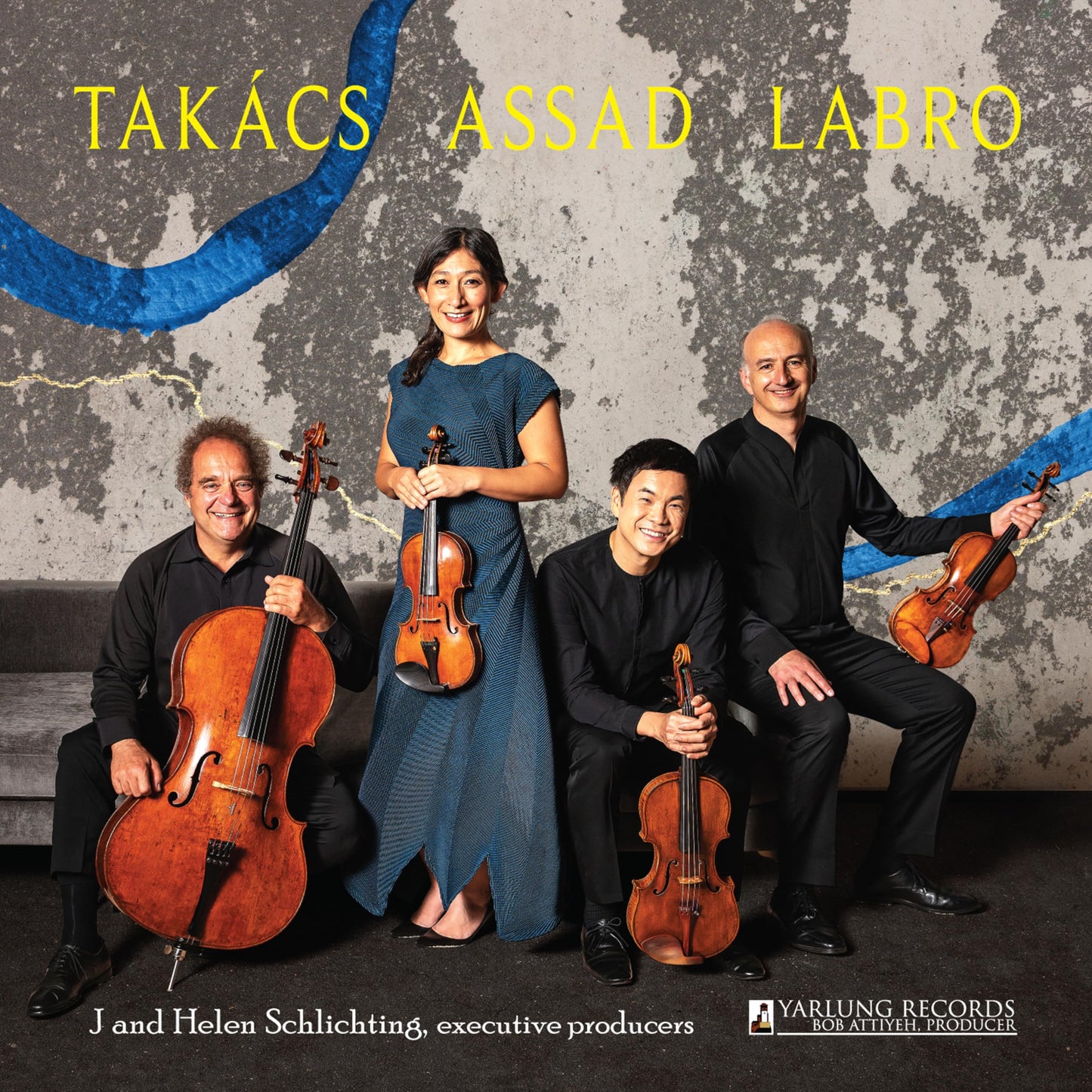

Takacs Assad Labro
Couldn't load pickup availability
Collapsible content
DESCRIPTION
EDITORIAL REVIEWS
My friend Clarice Assad called me out of the blue a few months after our album Confessions earned a GRAMMY® nomination. Clarice had written the title tracks on the album, which Laura Strickling sang magnificently. “Bob,” Clarice said, “I have an idea….” I have learned that anytime Clarice has an idea, I’m interested. “I wrote a piece for Takács Quartet and bandoneón virtuoso Julien Labro. It’s a wild piece. The five of them have been performing it all over the world on tour, and I think you would like it. Actually, I know you would like it. Julien wrote a companion piece, and the third work is by Bryce Dessner. I think you know Bryce; he lives in Paris. What a trio!” I responded that it sounded wonderful. “I want you to record these three works, plus another piece I have in mind for violin and piano. When can we do it?” Hence began one of Yarlung’s most adventurous (and I hope you will agree, successful) collaborations in the label’s nineteen year history. This album helps honor and celebrate the upcoming 50th Anniversary of the extraordinary Takács Quartet, formed in 1975 at the Franz Liszt Academy in Budapest by Gabor Takács-Nagy, Károly Schranz, Gabor Ormai and András Fejér. András remains cellist to this day. He was one of the original music student founders of the quartet, which would become one of the highest-ranked and best-loved string quartets in history. The group received its first international attention in 1977, winning First Prize and the Critics’ Prize at the International String Quartet Competition in Evian, France. The Quartet also won the Gold Medal at the 1978 Portsmouth and Bordeaux Competitions and First Prizes at the Budapest International String Quartet Competition in 1978 and the Bratislava Competition in 1981. The Quartet made its North American debut tour in 1982. Today’s members of the Takács Quartet are Artists-in-Residence at the University of Colorado in Boulder. Bryce Dessner’s Circles for String Quartet and Bandoneo´n opens our album on track 1. Bryce wrote that he was “fortunate to meet the wonderful bandoneo´n and accordion player Julien Labro a few years ago while I was composing the music for the Fernando Mereilles film, The Two Popes. I wrote a lot of music for Julien to play in the movie and was completely blown away by his exceptional musicianship and virtuosity. He seems to literally be able to do and play anything. So when Julien reached out and offered a chance to compose for him and the equally wonderful Taka´cs Quartet, I was very happy.” Bryce wrote Circles during the many months of Covid-19 lockdown in France. “This piece was an expression of the creative process slowly starting to turn again and come alive despite my isolation, each individual voice searching for a line and searching for one another and eventually creating a dance pattern together, weaving in and out of their evolving collective rhythm and individualist polyphony. This theme of the individual versus the collective voice is something I have been exploring a lot in my recent work.” Luminous, track 2 on our album, explodes with Clarice’s interpretation of the life-affirming power of Brazilian jazz. The percussive piano introduction launches the listener into the joyous syncopated rhythms and arching melodic lines associated with the genre. Luminous alternates duple and triplet sections in rondo form to drive the musical dialogue to a breathless and ecstatic conclusion, a celebration of life and music. Clarice, performing both voice and piano in this version, wrote Luminous as part of her Pendulum Suite. Julien’s Meditation No. 1, track 3 on our album, continues the trajectory initiated by Astor Piazzolla and Dino Saluzzi when they launched the bandoneón beyond its earlier role in Argentine folk music. As he prepared for our recording project, Julien told me he enjoyed thinking about the ECM bandoneón recordings released during the 1970s and 80s by Manfred Eicher. Cravo e Canela (Clove and Cinnamon) follows on track 4. This is a song by Milton Nascimento, one of Brazil’s most celebrated songwriters. Ronaldo Bastos wrote the Portuguese lyrics and the two created a classic Brazilian song that captures the essence of romance and the vivid colors of Brazil’s cultural tapestry. Clarice’s arrangement and performance breathes fresh energy into the song through her improvisation and innovative vocal techniques. (Clarice didn’t want to leave all the extended techniques on this album to her instrument-playing friends.) Here she explores vocal techniques that push the boundaries of her beautiful voice. This was a treat to record, as I think you will understand when you listen. J and Helen Schlichting kindly enabled Yarlung to commission Constellation, a three movement work for violin and piano, performed together in this recording on track 5. Clarice wrote for Harumi on violin and for herself on piano. The work celebrates Clarice’s nuclear family of four. Clarice directs that the movements can be played in any order. In our case, Harumi and Clarice perform Celestial first, in which Clarice envisions Stella, her as yet unborn daughter, still in the womb when Clarice composed it. (Stella was very much with us at the time of this recording.) Clarice’s instinct told her something of what beautiful Stella would be like. She arrived peacefully and possessed a sense of calm that Clarice confessed she had never encountered before. Estrellita (Little Star) comes next, a movement Clarice wrote as a children’s song for Antonia, Clarice’s older daughter, a little fireball of energy. “Antonia is like a shooting star, with bright eyes and a personality that fills our entire universe with excitement and bright colors.” This performance ends with Solais (Sunshine) a movement which pays homage and celebrates Clarice’s partner, evoking a sense of eternal, lasting love. It emanates warmth as this slow pulsating force sustains us, the revolving celestial bodies dancing around it in awe and gratitude. Thank you Harumi and Clarice for painting such a happy domestic musical picture for us, and thank you J and Helen for your generous commission. Harumi has always loved the music of Kaija Saariaho and suggested recording her Nocturne for solo violin as a part of this project. Saariaho wrote Nocturne in 1994 in preparation for her violin concerto Graal théâtre. She dedicated Nocturne to Witold Lutoslawski. I knew that Saariaho was struggling with terminal brain cancer and she died on June 2nd, 2023. I loved her and miss her and dedicate this album to Kaija Saariaho, her husband Jean-Baptiste Barrière, and their wonderful family. Clarice’s Clash, our final track on the album, is the hardest to describe. Perhaps also the hardest to play, but I will leave that to the musicians to decide. Clarice has been increasingly interested in tensions within the social fabric of our society, especially as exacerbated by incendiary politicians, climate change, mass migration and refugee issues. Indeed her opera, Isolda/Tristão, which premiered in São Paulo this past September, adjusts the story line we know from Wagner and the narrative of his 11th century predecessors to focus on refugees caught between the borders of two countries, and perhaps the borders between two states of existence. Clash is not program music and does not tell a specific story or illuminate a specific argument. But it does embody some of these same social struggles as expressed by the string quartet and bandoneo´n as these five instruments explore states of discord. “I started writing Clash in 2020 and finished in 2021, a turbulent period for many of us, made more painful by our world-wide health crisis and its subsequent social distancing, the potential collapse of our economy, riots and political turmoil, all stressful occurrences.” Clarice experimented with rhythmic ideas she took from human speech, especially argumentative speech, and contrasts those with patterns evolving out of human conflict resolution. Challenging as the work may sound at first, its beauty emerges as the stronger and unifying force, giving us hope for the future. As with all the music in this album, this too was recorded in one take. --Bob Attiyeh, producer
ADDITIONAL DETAILS
DELIVERY & RETURNS
UK Delivery:
- Free delivery on all orders of £10 or more.
- £1.49 delivery fee on orders below £10.
- UK orders are shipped via Royal Mail 2nd Class.
International Delivery:
- Flat rate delivery charges vary by country.
Dispatch and Delivery Times:
- All orders are shipped from our warehouse in Northampton, UK within 48 hours of receipt during working hours.
- UK mainland orders typically arrive within 3-5 working days via Royal Mail 2nd Class.
- International estimated delivery times:
- Europe & Channel Islands: 7 to 10 working days
- USA: 7 to 15 working days
- Rest of the World: 9 to 21 working days
View our full delivery infomation here.
-
OVER
2 MILLION PRODUCTS
-
60 MILLION CUSTOMERS
ACROSS 190 COUNTRIES
Fans of this product are also looking at...
Loading recommendations...